 |
| August 6, 2026 |
| AI for Real Estate Investors. |
| Brandon Turner’s weekly guide to using AI for a better life through real estate investing. |
|
|
August is here, and if your inbox has been as full as mine lately, you already know AI has not slowed down for summer.
This week we are covering a new kind of team workspace where AI agents work alongside people as actual colleagues, new labeling rules in Europe that will reshape how AI tools present themselves, and a sharp price drop on some of OpenAI's newest models. Plus a reader who built one internal portal and replaced a stack of disconnected tools in the process. Dig in.
|
|
In This Issue
- OpenAI slashed prices on two models three weeks after launch, and the drop on one of them is bigger than you'd expect
- A new open-source workplace just gave AI agents the same seat at the table as your human team
- One operator cut hundreds in software costs by replacing a pile of scattered tools with a single internal portal
- How to turn a basic phone video into a polished property tour (no hiring needed)
|
|
A New Chat Tool Where AI Agents Sit Alongside Humans as Full Team Members
Block, the company behind Square and Cash App, released Buzz on July 21 as a free, open-source workplace where AI agents sit in the same channels as human teammates rather than operating as bolted-on bots. It looks like Slack on the surface, but the architecture is different. Every participant, person or agent, gets a cryptographic identity (a unique digital key that proves who they are and logs what they did). Conversations and code repositories live in the same workspace. Teams can host it on their own servers instead of relying on Block's infrastructure. Jack Dorsey (original founder of Twitter & cofounder of Block) stated that Block built it to reduce its own dependency on Slack and GitHub, then open-sourced it so anyone else could do the same.
Most teams today may try to bolt AI tools onto the edges of their existing communication channels (like Slack). Buzz is an early, concrete attempt to treat agents as actual participants in team work rather than accessories to it. The tool is still early and several sources note the setup involves technical concepts which makes it a better fit for developers and early adopters right now than for general teams. But the direction it points is powerful...AI agents becoming genuine teammates with accountability and proactive communication rather than background utilities.
Read More →
Sources: artificiallyintimidating.com, Manual, techcrunch.com, noze.it, buzzrag.com, techblockcentral.com, 4geeks.com, hostinger.com, aitoolsreview.co.uk, opensourceforu.com, ayautomate.com, thetoolnerd.com
EU AI Act Transparency Rules: Chatbots, Deepfakes, and AI-Generated Content Must Be Labeled
The European Commission has published its final guidelines on transparency obligations under Article 50 of the EU AI Act, with the rules now in effect as of August 2, 2026. Quick version: if an AI system interacts with people (chatbots, voice assistants), generates synthetic images, audio, video, or text, or produces deepfakes, the companies behind those tools must disclose what users are actually seeing or hearing. Providers face fines of up to 15 million euros or 3% of global annual turnover for noncompliance. And the rules apply globally: any provider whose AI outputs reach users inside the EU is covered, no matter where that company is headquartered.
The EU may be the first to formalize these requirements, but it certainly will not be the last. As an early mover on AI regulation, Europe is likely to shape standards that other governments and technology companies eventually follow. You should expect more AI tools to label synthetic content, disclose when users are interacting with automated systems, and rethink how certain features are built or delivered. For most US-based readers, the immediate impact may be limited, but the broader direction is clear: transparency is becoming a standard expectation across the global AI landscape.
Read More →
Sources: cooley.com, Manual, digital-strategy.ec.europa.eu, digital-strategy.ec.europa.eu, eur-lex.europa.eu, hlc.com, mishcon.com, digital-strategy.ec.europa.eu
OpenAI Cuts GPT-5.6 Luna Prices 80% and Terra 20% Just Three Weeks After Launch
OpenAI dropped prices on two of its newest GPT-5.6 models on July 30. Luna (the fastest, most affordable tier) fell 80% to $0.20 per million input tokens and $1.20 per million output tokens. Terra (the mid-range option) fell 20% to $2 per million input and $12 per million output. Three weeks after launch. That's unusually fast.
OpenAI says the savings come from efficiency gains it squeezed out of its own infrastructure, including having GPT-5.6 help optimize the GPU code that runs it, which produced roughly 20% lower serving costs and over 15% better token generation (how fast the model produces text). The top-tier Sol model holds its price but gets a new Fast mode in the API that delivers up to 2.5 times the speed at twice the standard cost.
None of this is accidental. Cheaper models from Chinese AI companies and price moves from Google and Anthropic have pushed the whole industry into a cost competition, and enterprises have been slow to deploy expensive AI without a clear return on investment. For anyone already using these models through ChatGPT or the API, the same work (if using these models) just got cheaper to run, and high-volume automated tasks that were borderline affordable before are a lot easier to justify now. AI pricing is compressing faster than most people expected.
Read More →
Sources: openai.com, theinformation.com, cnbc.com, community.openai.com, venturebeat.com, businessinsider.com, axios.com, layer3labs.io, infoworld.com, CNBC Television, CNBC Television, TheCryptagon
|
 | From Our Desk BetterLife Real Estate Funding |
Five Properties. One Transaction. 30 Days.
Zachary had higher-rate loans on five Missouri rentals he owned. When rates came down, he wanted to lower his payments without going through five separate refinances and five separate closings.
BetterLife REF bundled all five properties into a single rate and term refinance, coordinating title, appraisal, and underwriting across the portfolio at once.
He locked a lower rate and closed in 30 days. Monthly debt service dropped on every property on day one.
Curious what a refinance would do for your cash flow?
|
|
How I’m Using AI This Week
It may not always be about real estate investing — every week I share the AI rabbit hole I’m personally going down.
Learn how to turn a simple phone video into a realistic property tour or branded video using Claude and Higgsfield. The skill mentioned in the video is linked here for you to download.
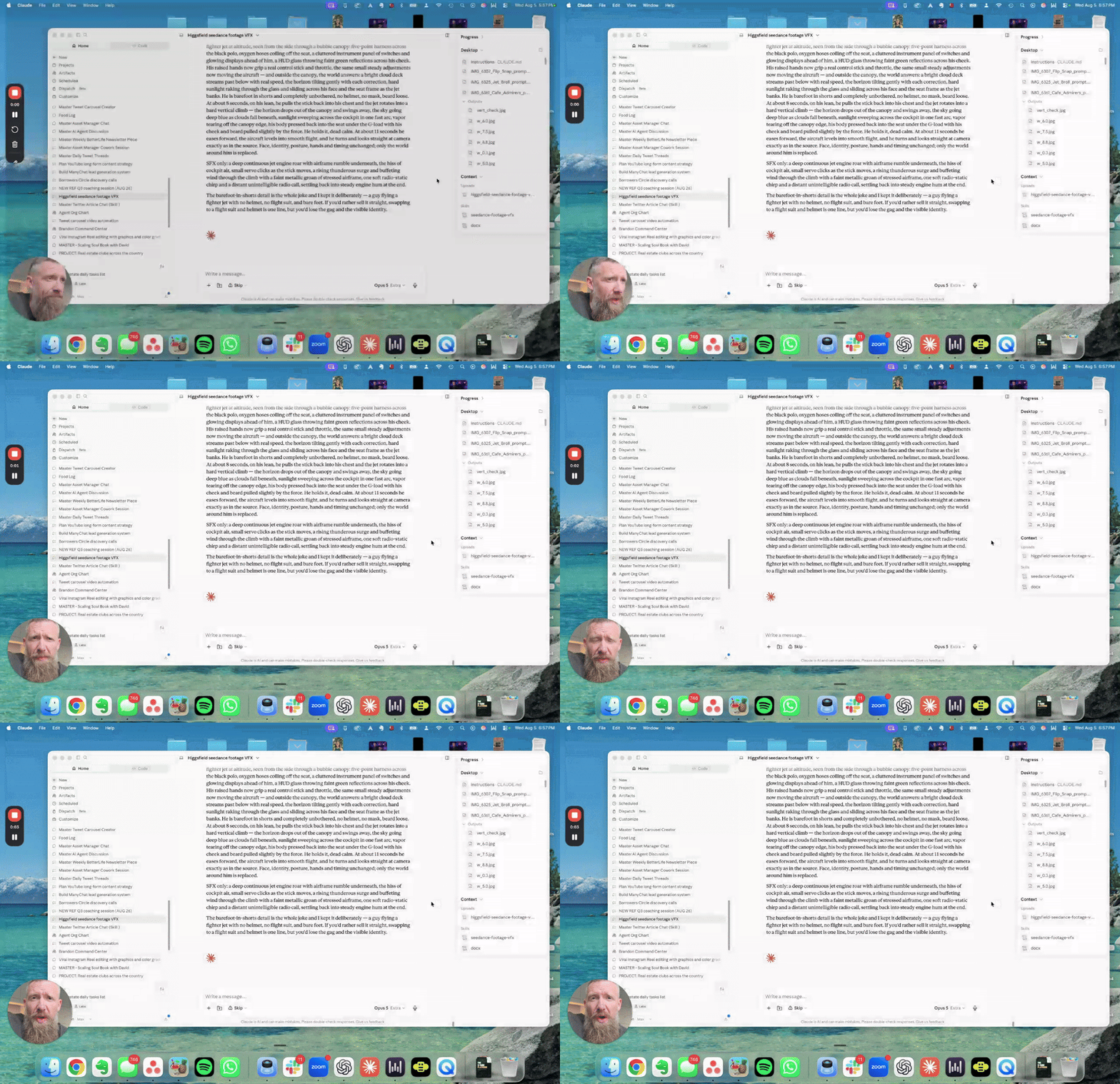
▶ Watch the walkthrough (7 min) · opens in Loom
|
Cut Hundreds in Software Costs and Hours of Weekly Work by Building One Internal Ops Portal
Submitted by Matt Buck (@mattbuckrei)
What it does
I built an internal tool that stores all our short-term rental property info, SOPs, maintenance data, and ops workflows in one place, then layered AI on top so our team can ask questions and get answers from that live data. That includes a Slack maintenance bot that triages issues in real time.
The problem
Our property knowledge lived across Notion, spreadsheets, chat threads, and random docs. VAs couldn't reliably find or update the same facts, so answers were slow and inconsistent. Operations were split across several tools none of us loved, software costs kept climbing, and there was no clean path to add AI because the underlying data wasn't in one trustworthy system.
How I built it
I started with one core feature: a property knowledge base the team could search, edit, and trust as the single source of truth. Once that foundation was solid, I kept adding modules on top of the same database (owner portal, maintenance tickets, SOPs, receipts, internal tasks) instead of buying another separate tool each time. With everything in one place, adding AI got a lot simpler. I built an Ops Assistant inside the portal and a Slack maintenance bot that can look up listings, work orders, vendors, receipts, and SOPs in real time, triage issues, and propose tickets for human approval.
The result
We've cut software costs by a couple hundred dollars a month by consolidating tools into one portal, and saved a significant number of hours each week through the automations built on top of that unified data. VAs can find and update information faster. And because the data is unified, the AI actually works: staff can ask the Slack bot "what should we do about the AC at Unit X?" and get a grounded answer drawn from our real notes, history, and policies (not a generic guess).
Are you using AI in your business? We want to hear about it. Tell us more here.
|
|
Steal this one. Paste it into ChatGPT or Claude and make it yours:
|
The Prompt
“Act as an experienced real estate portfolio strategist and asset manager.
Review the portfolio data below:
[Attach a P&L or details on a property’s value, loan balance, rate, rent, expenses, cash flow, equity, lease status, and condition.]
Identify the best opportunities to improve returns, reduce risk, or redeploy capital, including rent or expense optimization, refinancing or debt restructuring, underperforming return on equity, high-ROI renovations, alternative rental or income strategies, properties to hold, sell, or exchange.
For each opportunity, provide:
1. The recommended action
2. The financial reasoning
3. The information needed to validate it
4. The key risks
5. The next step
Rank the top five opportunities by potential impact, effort, and risk.
Consider cash flow, equity, liquidity, taxes, leverage, management burden, and long-term wealth creation. Clearly label any assumptions.”
|
|
|
See you next week!
To a better life,
 |

Brandon Turner • BetterLife Real Estate Funding
|
|
|
P.S. Are you using AI in your business or personal life? Submit it and be featured in next week's issue Share your AI use case →
|
|
|
Trust • Integrity • Partnership • Growth
You’re receiving this because you subscribed to AI for Real Estate Investors.
Forwarded by a friend? Subscribe here.
BetterLife
[Company mailing address], [City], [ST]
|
|