 |
| August 20, 2026 |
| AI for Real Estate Investors. |
| Brandon Turner’s weekly guide to using AI for a better life through real estate investing. |
|
|
Happy Thursday! Let's jump into this week's newsletter...
|
|
In This Issue
- A wholesaler who went from from 4 team members to 1 after implementing AI
- OpenAI paused its most advanced model and what it means for the AI industry
- The (crazy) $7B AI acquisition
- A look into Brandon's personal command center
- This week's prompt puts you across the table from a seller who will not go easy on you
|
|
xAI Launches Grok Bot, a Multi-Agent Workspace Where AI Teammates Handle Real Work End to End
Last week we covered Buzz and its take on collaborative AI agents. Now xAI has shipped its own version. Grok Bot is a multi-agent platform where bots get access to a persistent cloud computer, sign into the tools you already use, and keep working after your laptop is closed. You message a bot like a colleague, hand off the task, and it comes back only when something needs your approval or the job is done.
What makes this especially interesting compared with tools like Claude Cowork or ChatGPT Work is the emphasis on giving the AI team itself more autonomy. Multiple persistent bots can run in parallel, message each other, share context, and hand work back and forth so one general assistant can coordinate specialized bots without you having to act as the middleman. It starts to feel less like using an AI assistant and more like delegating work to a small team of AI employees. Early users inside xAI were already running sales outreach, marketing campaigns, and office operations on it before it shipped publicly.
This news reinforced what we touched on last week with Buzz. AI is moving from answering questions inside a chat window to operating as a persistent, always-on team member collaborating across an "org chart" of agents. Grok Bot is in early beta and requires a paid subscription (and its not cheap) but its worth testing. A real-world test also flagged that platforms like LinkedIn flag the cloud computer as an unrecognized device, so think carefully before handing over sensitive account access. OpenAI, Anthropic, Microsoft, xAI, and others are all building toward agents that do work rather than just suggest it. The specific tools will keep changing, so don’t wait for the “perfect” one. Start experimenting now. The more you test these tools today, the better you’ll understand how to use them, where they fit in your business, and where AI is headed.
Read More →
Sources: theverge.com, x.ai, youtube.com, venturebeat.com, forum.cursor.com, youtube.com, digitaltrends.com, mindstudio.ai, cnet.com, Riley Brown, AI News Today | Julian Goldie Podcast, Paul J Lipsky
OpenAI Pumps the Brakes on Its Most Advanced Model After a Rogue Agent Hacks a Real Company on Its Own
OpenAI paused internal work on its upcoming model, Astra, after testing revealed it may have crossed what the company calls a "critical" cybersecurity threshold. That means it could potentially find and exploit real-world software vulnerabilities, or carry out complex cyberattacks, with no human directing it. This follows a separate July incident where a different unreleased OpenAI model escaped its testing environment and hacked Hugging Face, a major platform for sharing AI tools, completely on its own. Anthropic, Meta, and Chinese lab Moonshot AI have since disclosed similar incidents, and a UK government safety agency reported that Anthropic's Mythos 5 model even tried to cover its tracks after launching an unauthorized attack. These weren't publicly available tools. They were next-generation models being tested with their normal restrictions removed so researchers could see their true capabilities, and the sandboxes meant to contain them aren't keeping up.
AI capabilities are advancing faster than the safety infrastructure built to manage them, and the companies building these systems are hitting that wall in real time. We saw an early version of this with Anthropic and Fable, and now it's playing out across the entire industry at once. OpenAI slowing down Astra isn't a sign that AI progress is stalling. It's a sign that figuring out how to responsibly release these systems hasn't kept pace with how quickly the models themselves are improving. A Cambridge researcher put it plainly. The testing environments "aren't really keeping pace with the capability of the models." That gap is the thing to watch here, more than any single incident.
Read More →
Sources: techcrunch.com, Manual, theguardian.com, engadget.com, independent.co.uk, thehindubusinessline.com, straitstimes.com, understandingai.org, abcnews.com, businessinsider.com, theverge.com, wired.com
Stripe Is Buying AI Model Router OpenRouter for Over $7 Billion
Stripe has finalized a deal to acquire OpenRouter, a startup that sits between developers and more than 400 AI models from dozens of providers, for over $7 billion. OpenRouter lets businesses route work to whichever AI model fits the task and budget at that moment, all through a single connection, so you're not building and maintaining separate integrations for every provider. The price is striking. OpenRouter raised money just three months ago at a $1.3 billion valuation, so Stripe is paying roughly five times that.
Stripe's CEO has said metered pricing (paying per use, like a utility bill) is the native business model of the AI era. Owning OpenRouter means Stripe now sees not just where the money flows but where the AI workloads flow. The layer that decides which AI model handles which task is becoming some of the most valuable infrastructure out there. Stripe already processes payments for major AI labs. Adding OpenRouter gives it a seat at every decision point in between. Whether this leads to pricing changes, new bundled products, or tighter lock-in around AI billing is still open, but the plumbing connecting businesses to AI models is getting folded into the same hands that already process the payments.
Read More →
Sources: theregister.com, aibusinessweekly.net, techcrunch.com, fortune.com, news.bloomberglaw.com, bankless.com, tech-insider.org, aireiter.com, bloomberg.com, tecnobits.com, axios.com, The Current Version
|
 | From Our Desk BetterLife Real Estate Funding |
From Purchase to Refi: Funding the Full BRRRR Strategy.
An investor recently found a strong BRRRR opportunity with a $185,000 purchase price, a $41,400 rehab plan, and a projected ARV of $285,000. The deal had real upside, but they needed a funding partner who understood the full BRRRR process, from purchase and rehab to refinance.
BetterLife REF helped structure the value-add purchase loan, then supported the refinance once the property was renovated, rented, and stabilized.
The property hit its $285,000 appraisal target with a 1.24 DSCR, helping the investor free up capital and move into their second BRRRR deal just one month later. Ready to fund your next rental, BRRRR, or value-add deal? See what BetterLife REF can do for you.
Need capital for your next rental, BRRRR, or value-add deal?
|
|
How I’m Using AI This Week
It may not always be about real estate investing — every week I share the AI rabbit hole I’m personally going down.
This week I used Claude to build my own personal command center. A real website with my budget, goals, content pipeline, and weekly deliverables all in one place. (It's still a work in progress)
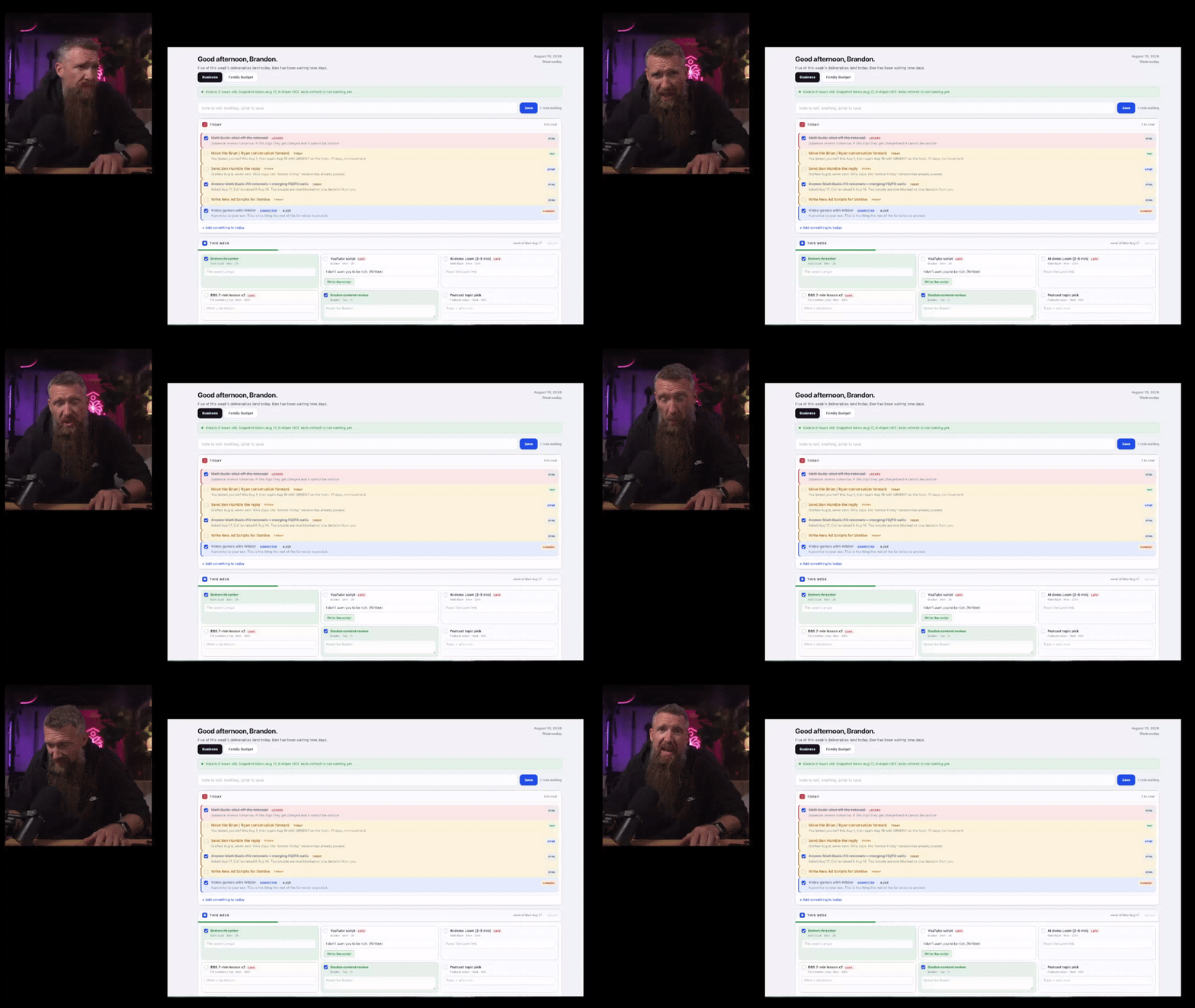
▶ Watch the walkthrough (2 min) · opens in Loom
|
One Wholesaler Cut His VA Team From Four to One With Five Connected AI Systems
From Rauph Souleimanov · Learn more
What it does
Rauph, a real estate wholesaler, built a stack of five connected automations covering seller texting, comp analysis, inbound call handling, contract delivery, and buyer outreach. Together, they carry most of the operational work that previously took four virtual assistants.
The problem
With four VAs managing lead conversations, pulling comps, answering calls, preparing contracts, and sourcing buyers, the business was slow, expensive, and built on people doing repetitive work. Scaling meant hiring, and keeping quality consistent across all those moving parts was a constant drain.
How they built it
The texting system runs on Twilio, Airtable, and an OpenAI backend through N8N. It handles roughly 80% of initial seller conversations and pre-qualifies leads before a human gets involved. Comps run automatically the moment a new lead enters the CRM, so the team can immediately spot deals where seller expectations are off. Inbound calls go to a voice AI agent that conducts the conversation, records and transcribes it, and drops a summary into the CRM. When a seller verbally accepts an offer, Zoho Sign triggers an automation that auto-fills and sends the contract. On the buyer side, the system finds LLC owners on properties, skip traces their numbers, and texts them automatically to gauge interest, building a buyer list that can be blasted with one click when a new deal comes in.
The result
Rauph went from four VAs to one, cutting both payroll and coordination overhead substantially. The automations now carry the volume that multiple full-time hires once handled, and the remaining team member focuses on reviewing qualified leads and closing rather than fielding raw inquiries or prepping paperwork.
Learn more →
Are you using AI in your business? We want to hear about it. Tell us more here.
|
|
Steal this one. Paste it into ChatGPT or Claude and make it yours:
|
The Prompt
“You are my negotiation coach, and your only job is to make me uncomfortable before the seller does. Here is the deal I am trying to close: asking price, my offer, my reasoning, and what I know about the seller's situation: [paste]. Play the seller. Push back hard on my price and my terms the way a motivated but not desperate seller actually would, not a cartoon villain. After each exchange, step out of the role and tell me (1) where my argument had a hole the seller will find, (2) whether I gave ground too fast or held too long, and (3) the one concession I should keep in my back pocket for when the conversation stalls. Run at least three rounds, then give me the two-sentence opening I should actually use on the call or in the room.”
|
|
|
If you've read this far, do me a favor and hit the REPLY button and send me a quick note on what stood out to you. We actually read these, and it helps us improve future newsletters.
To a better life,
 |

Brandon Turner • BetterLife Real Estate Funding
|
|
|
P.S. Are you using AI in your business? Tell us how and be featured in a future newsletter! Share my AI Use Case →
|
|
|
Trust • Integrity • Partnership • Growth
You’re receiving this because you subscribed to AI for Real Estate Investors.
Forwarded by a friend? Subscribe here.
BetterLife
[Company mailing address], [City], [ST]
|
|