 |
| September 10, 2026 |
| AI for Real Estate Investors. |
| Brandon Turner’s weekly guide to using AI for a better life through real estate investing. |
|
|
Happy Thursday from wherever you are reading this.
Three big AI stories landed this week, and one of them might be the most significant thing you have read in this newsletter. GPT-6 Astra shipped, a 90-year-old math problem fell, and Meta released an agent that manages your email and books your travel without you lifting a finger. Below is what each one actually means for you as an investor.
|
|
In This Issue
- OpenAI just solved a problem that stumped mathematicians for 90 years
- Meta launched an AI agent that takes action inside your apps on your behalf
- A ChatGPT experiment produced a fully playable 3D game in about 20 prompts, running on an iPad
- One prompt that reads your deal summary the way a skeptical passive investor would, before they pass on it
|
|
OpenAI Launches GPT-6 Astra and Says the AGI Era Has Begun
OpenAI shipped GPT-6 Astra on September 3rd, and company president Greg Brockman closed the launch briefing with a line that got everyone's attention: "Welcome to the AGI era." AGI (artificial general intelligence) is the long-stated goal of building a system that outperforms humans at most economically valuable work without needing a person to guide every step. Brockman said he believes Astra either meets that bar or comes close enough that future observers will look back at this moment as when it happened. That's a big claim for a major AI lab to say out loud, which is why the AI community is treating this release as something different from a normal model upgrade.
Beyond the AGI framing, Astra is noticeably better at actually operating a computer on your behalf. On OSWorld 2.0, a benchmark that measures how well a model can navigate real software, Astra scored 72.6% and finished tasks in about 40 minutes compared to 75 minutes for its predecessor. Its ability to click the right button in the right app jumped from 76.9% to 92.7%, and its score on multi-step automation tasks more than doubled. The demo OpenAI released shows Astra ordering food, building a slideshow, and coding a game all at once, handling each by clicking around and browsing like a person would. It also scored highest on ARC-AGI-3, a benchmark built specifically to test whether AI can solve problems it has never seen before. That's the capability researchers watch most closely when debating whether AGI is near. Benchmarks are imperfect, and independent labs disagree on exactly how much Astra beat its rivals, including Anthropic's Claude Fable 5.1 that we covered recently. But AI is clearly moving from a tool that answers questions into something that takes over the work itself, and Astra is the furthest along that road yet.
Read More →
Sources: venturebeat.com, OpenAI, theverge.com, openai.com, engadget.com, deploymentsafety.openai.com, community.openai.com, the-decoder.com, business-standard.com, the-decoder.com, mindstudio.ai, au.pcmag.com
Meta Launches Muse, a Personal AI Agent That Takes Action on Your Behalf
Meta officially introduced Muse this week, an AI agent built to do more than answer questions. It sends emails, books travel, fills out forms, tracks long-term goals, and works across the apps you already use. It runs inside a dedicated secure virtual machine called Muse Secure VM that keeps your data separate from Meta's broader systems, and you stay in control of what it can access. The underlying model, Muse Spark 1.3, is Meta's most capable yet. An independent evaluation put it just behind Anthropic's Claude Fable 5.1 in overall intelligence scores and ahead of current OpenAI models on coding tasks.
For anyone running a business with a full inbox and a long to-do list, the appeal is obvious. An agent that can find a document buried in email, complete it, check your calendar, confirm an action, and set a reminder is the kind of admin offload that used to require hiring someone. The catch is that Muse is still in a limited closed alpha with a waitlist, and pricing (one report cited around $200 a month) has not been confirmed by Meta. Keep an eye on this one. The race to ship capable personal agents that handle real multi-step work is moving fast, and when products like this mature they could meaningfully cut the time operators spend on administrative overhead.
Read More →
Sources: Manual, aiinsiders.net, digitaltrends.com, progressiverobot.com, techedt.com, siliconangle.com, Fireship, Weeklyclaw, OpenAI, Smashed Tomatoes
OpenAI Just Cracked a 90-Year-Old Math Problem That Stumped the Greatest Minds in History
One of the most famous unsolved problems in mathematics, open for roughly 90 years, was just cracked by an AI. OpenAI announced that an internal model, described as significantly more capable than GPT-6 Astra, produced a proof for the Navier-Stokes existence and smoothness problem. That's one of only seven Millennium Prize Problems designated by the Clay Mathematics Institute, each carrying a $1 million prize. The Navier-Stokes equations describe how fluids move and show up in everything from aircraft design to weather forecasting, but whether their solutions could mathematically break down under certain conditions had never been proven either way. Now it has. OpenAI also released a computer-verifiable version of the proof written in a formal language called Lean, so any mathematician in the world can check the work step by step.
This goes well beyond big math questions. AI is now operating at the frontier of human knowledge, resolving questions that entire generations of the world's sharpest people could not answer. This follows Anthropic's Claude formalizing a computer-checked proof of Fermat's Last Theorem just days earlier, a separate landmark that required 13 million lines of code written autonomously in 11 days. Two results like that in the same week suggest the pace of AI progress is moving faster than most people appreciate. OpenAI said plainly that part of their reason for sharing this is to give the world a realistic sense of what is coming next. You don't need a position on fluid dynamics to feel the weight of AI closing problems that humans spent a century failing to close.
Read More →
Sources: Manual, mathstodon.xyz, stanfordtechreview.com, news.lavx.hu, eu.36kr.com, htx.com, anthropic.com, nature.com, newscientist.com, thenextweb.com, applyingai.com, blog.4sapi.com
|
 | From Our Desk BetterLife Real Estate Funding |
92.5% Financed. $190K Profit.
Aaron found a Phoenix property that needed a full interior overhaul. The numbers worked at $385,000 purchase with a $110,000 rehab budget, but a deal like that only pencils if you're not tying up all your own cash to close it.
BetterLife REF financed 92.5% of total project cost, so Aaron kept most of his capital free to move on the next deal while this one was still under construction.
He gutted the kitchen and baths, replaced the flooring and windows, and sold seven months later for $685,000. About $190,000 in gross profit. Ready to fund your next flip? See what BetterLife REF can do for you.
Need capital for your next fix and flip?
|
|
How I’m Using AI This Week
It may not always be about real estate investing — every week I share the AI rabbit hole I’m personally going down.
My son and I used ChatGPT Astra to build a fully playable 3D fort-building game in about 20 prompts, and it even runs on his iPad.
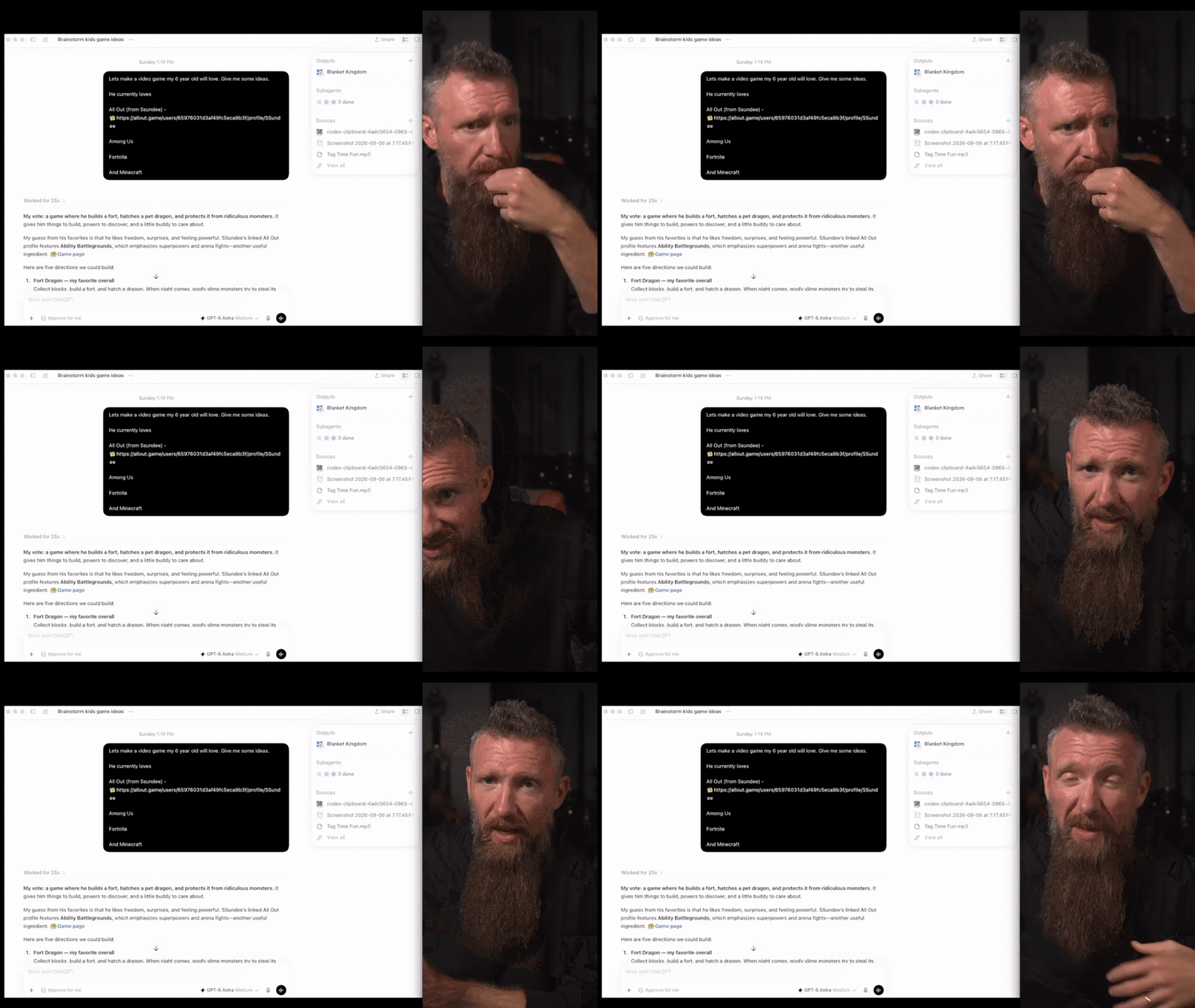
▶ Watch the walkthrough (4 min) · opens in Loom
|
Build a Before-and-After Property Condition Record Without Digging Through Your Camera Roll
What it does
This workflow turns your spoken walkthrough notes and phone photos into a structured condition report at move-in, then compares that record against your move-out documentation. AI organizes the observations by room, matches photos to the right items, and produces a side-by-side comparison showing what changed. The sorting and formatting happen automatically, so you spend time reviewing evidence rather than hunting for it.
The problem
You took the move-in photos. Somewhere. Now the tenant has moved out, there is a stain on the bedroom carpet, and you are scrolling through hundreds of undated images trying to figure out whether it was already there. The photos exist, but connecting them to the right room and the right date turns into its own time-consuming project every single time.
How you build it
Walk the property room by room and narrate what you see. Use your phone's voice memo app, your AI app's voice feature, or a transcription tool to capture what you say, and say the room and item name out loud before each observation. Photograph as you go, including close-ups of existing damage, and keep filenames or folder labels tied to each room so the images can be matched to the notes later.
Give the transcript and photos to ChatGPT or Claude and ask it to produce a condition report organized by room, with each observation tied to its supporting photo. Include the property address and inspection date. Tell it to flag anything unclear rather than fill in gaps. At move-out, repeat the process, photographing the same areas from similar angles. Upload both sets and ask AI to compare them, noting what appears unchanged, what appears different, and what needs a closer look. Request captions explaining visible differences and matched before-and-after photos placed side by side. If two photos do not clearly correspond, keep that comparison marked uncertain. To automate the filing step, connect ChatGPT or Claude to Google Drive and have it save the transcript, photos, and completed report into a dedicated property folder, then generate the condition form in Google Sheets or Google Docs. Moving photos directly from your phone still requires a manual upload or a sync setup on your end.
The result
You end up with a dated, room-by-room property history you can actually use when a deposit dispute comes up. Observations are organized, photos are matched, and the comparison report shows where conditions appear to have changed between move-in and move-out. This also helps better document and organize any proof of damages necessary to withhold a security deposit from a tenant if needed.
Are you using AI in your business? We want to hear about it. Tell us more here.
|
|
Steal this one. Paste it into ChatGPT or Claude and make it yours:
|
The Prompt
“You are an investor relations writer who has seen pitch decks lose money for sponsors and limited partners alike. Here is my deal summary, projected returns, and the terms I am offering: [paste]. Read this exactly the way a skeptical passive investor with three other deals on their desk would read it. List every claim that sounds optimistic without support, every number that needs a source, and every term that a sophisticated LP would push back on. Then rewrite the weakest two paragraphs so they make the same case with evidence instead of enthusiasm. End by telling me the single question this deck does not answer that will come up in every conversation, and give me a two-sentence answer I can use when it does.”
|
|
|
If you've read this far, do me a favor and hit the REPLY button and send me a quick note on what stood out to you. We actually read these, and it helps us improve future newsletters.
To a better life,
 |

Brandon Turner • BetterLife Real Estate Funding
|
|
|
P.S. Looking for funding on your next investment? Get a quote from BetterLife Real Estate Funding today. Get a quote →
|
|
|
Trust • Integrity • Partnership • Growth
You’re receiving this because you subscribed to AI for Real Estate Investors.
Forwarded by a friend? Subscribe here.
BetterLife
[Company mailing address], [City], [ST]
|
|